CONTEXT & BELONGING
Excerpts from Clay Seminar No. 3. June 23, 2022
CONTEXT & BELONGING
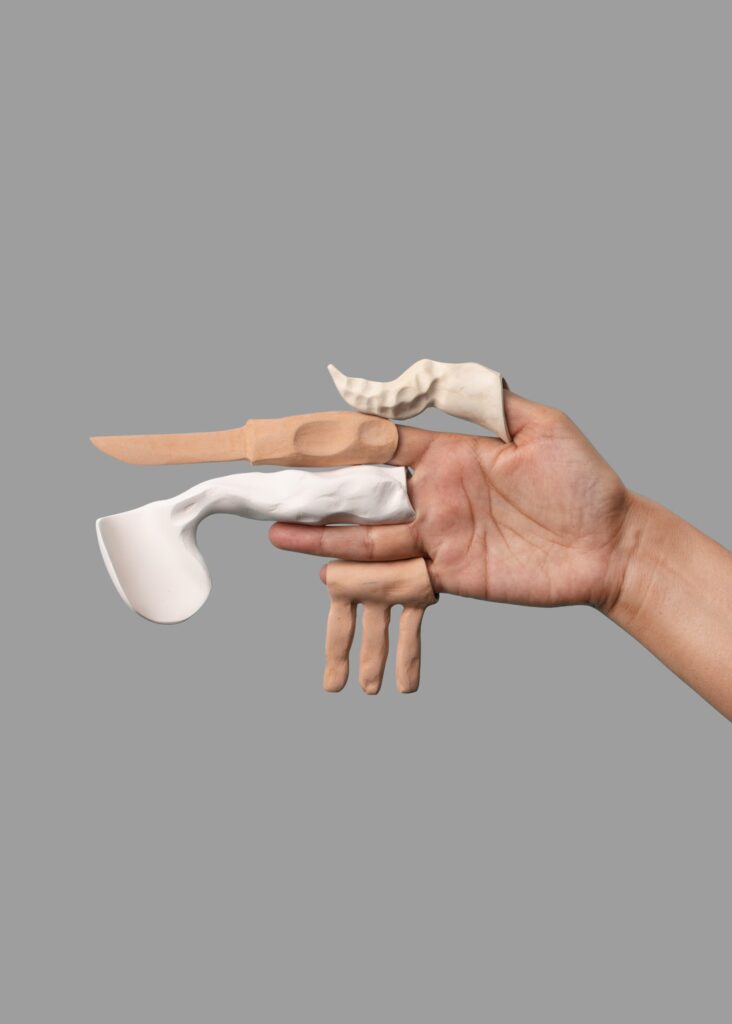
(featured image: Neha Kudchadkar – Hand Job, 2018)
Speakers: Nia Gautama > Artist, writer, educator (Indonesia); Neha Kudchadkar > Artist and co-curator, Indian Ceramics Triennale (India); Dr Samuel Nortey > Artist and Associate Professor, Dept. of Industrial Art Ceramics, Kwame Nkrumah University of Science & Technology (Ghana).
Acknowledging that the medium of clay has a global history of creative and cultural significance, three invited speakers explore approaches to and the ambitions of clay practices. All reflect on issues affecting the current moment and future of ceramic art and craft in their global region. (Introductory text: Tessa Peters, 2002)
NG: Indonesian modern ceramic art dates from 1963 when the art school of the Institute of Technology Bandung (ITB) opened a clay studio. One senior alumnus of ITB is F. Widayanto, a ceramic sculptor who also produces handmade housewares; and Kandura is a business founded by a younger generation of four ITB graduates who design and produce handmade, limited edition ceramic tableware and run public workshops; Albert Yonathan Setiawan’s work is characterised by his use of repetitive ceramic pattern, and he also creates performances using ceramic materials and makes drawings; I studied for an MFA at ITB and explore women’s issues using ceramics, mixed media and performance. My work Serving and Giving (2019) refers to a domestic object: the napkin. The idea of the work is to raise the social status of ‘serving’ (domestic tasks) and sharing (giving) love. The Raped Love (2016), a performance and installation, including ceramic elements, reveals how a woman’s calm countenance tends backfire on herself, placing her in a fragile position or conditions that stunt her sense of Self. Aside from ITB-trained artists, Jatiwangi Art Factory (JaF) is a community-based art collective in an area of West Java known for its terracotta roof tile industry. JaF transform roof tiles into musical instruments, performing large-scale orchestrated actions, and recently performed at Documenta 15 (2022) in Germany. These are some examples of different strategies taken by Indonesian designers and artists working with ceramic.
NK: I’m looking at a sliver of practices from a vast, complex landscape of clay and ceramic cultures; these cultures have been in conversation for years and have informed each other and complemented each other. Yet, as everything in the subcontinent … they are not without their own chaos, conflicts and cliches. They are all meaningful to me, having shaped and bolstered my understanding of the possibilities of the clay world. All but one of the contemporary artists whose work I discuss are good friends … it is a selection of practices that suits my eco-feminist narrative:
Rashi Jain embodies deep silences and channels her kundalini to find the sacred in herself; Anjani Khanna confronts our political realities … our rage … our compliance; Benitha Perciyal’s figures are another confrontation with the deep fractures in Indian society today; Sharbani Das Gupta talks about borders and walls in her work … She lives at the border of the USA and Mexico. In my three short guerilla performances of home/land (2016), I address notions of ownership and control, and rootedness and uprootedness, and play with the materiality of clay. This preoccupation with the body and the clay continues when I layer my two primary materials digitally: layers of skin, earth, history, knowledge, guilt, prejudice, myth, memory, power and movement are fossilised into a group of photographs. Madhvi Subramanian, currently based in Singapore and of Indian origin, talks about the history of indentured labour and the movement of bodies between India and the Far East; Elodie Alexandre explores notions of mental health and care … My work Handjob (date), also talks about care and mediated care.
SN: Indigenous practice has been the foundation for Ghanaian ceramic practice … although it’s been marginalised. Firstly, such practices provide very interesting examples of traditional techniques, which may be destined to disappear as industrialisation proceeds. Secondly, they present an opportunity for governments (Ghana and beyond) to develop these traditional industries. Women are the makers of ceramics in Ghana. They work collaboratively, producing wares that are used in domestic homes – to serve their families and their entire community. They produce domestic earthenware bowls which we call ‘apotoyowa’ that are used for several delicacies and for shredding vegetables. In comparison to thousands of mass-produced cups that can be fired within a few hours, a traditional woman potter produces 60 – 80 earthenware bowls a week. The industrial pots are cheaper but, as well as this, the handmade ceramic bowls are being replaced by plastic bowls that are even cheaper. The apotoyowa is also threatened by the electric blender, that is now used to shred vegetables.
I am looking at the challenge of traditional pottery becoming endangered; the average age of potters is now around 50 years and younger women are not really interested in taking up this indigenous cultural practice – and if they don’t, we risk losing it. I believe the way forward is a strong synergy between traditional practices and academia … As a university professor, I have brought traditional women potters to my classroom to teach my students. They have the skills and they’ve been practising them for no less than 40 years. Our students are interacting with these local practitioners, and after this synergy and collaboration, students and artists are beginning to recontextualise their products.
The traditional pots made by these women are used in F. E. Okai’s Light Soup (date). I also use the traditional pots in an installation called Building Bridges (date). I believe that for the contemporary and the traditional to collaborate you must build bridges. I dream that we can bring this tradition into the contemporary space. The need for the cross-fertilisation of skills and knowledge is key to the sustainable development of a practice, such as ceramics – and there is more to learn from each other.
On the synergy between traditional and contemporary ceramics …
NG: In Indonesia there’s a mission to turn to curators to unite tradition and the contemporary. The Indonesian Contemporary Ceramics Biennale is a place where tradition and the contemporary can intertwine. And, although Jatiwangi is an industrial village, JaF wish to keep the clay valued … They invite artists and educators, both traditional and contemporary, to work together with the villagers. They keep the tradition – they still use the roof tiles – but they remind people in the village that the earth, the soil, the clay must be appreciated.
NK: I think that traditional practices are contemporary in that they are not dead. They are living practices. At the same time, in India, they have been quite separate – as practices have been passed down through family lineage … Something the Indian Ceramics Triennale team talk about is bringing these practices into gallery spaces. But is this something that is enforced or directed by us as outsiders? Is that a direction these practitioners want to take?
NG: Some lecturers in Indonesia bring students to their village to learn from local potters. Because these potters focus on the technical aspects of making the pots, the students and lecturers can help them to develop their designs. But we do not aim to interfere. The ideas are based on the potters’ tradition, and we just suggest developments – we don’t change their style. I think we can learn from each other.
SN: When I started working with the traditional potters, I recognised their enthusiasm … the opportunity to interact with university students is really a great one for them. But I do not have much support from the university. In time, people may come on board, but for now it’s just a personal project with no funding. In my visits to the potters, I look at their kilns to see if I can improve them. There is excitement among the traditional potters, but I also see excitement and satisfaction on the part of my students.