THE WHOLE WORLD IN OUR HANDS by Martina Margetts
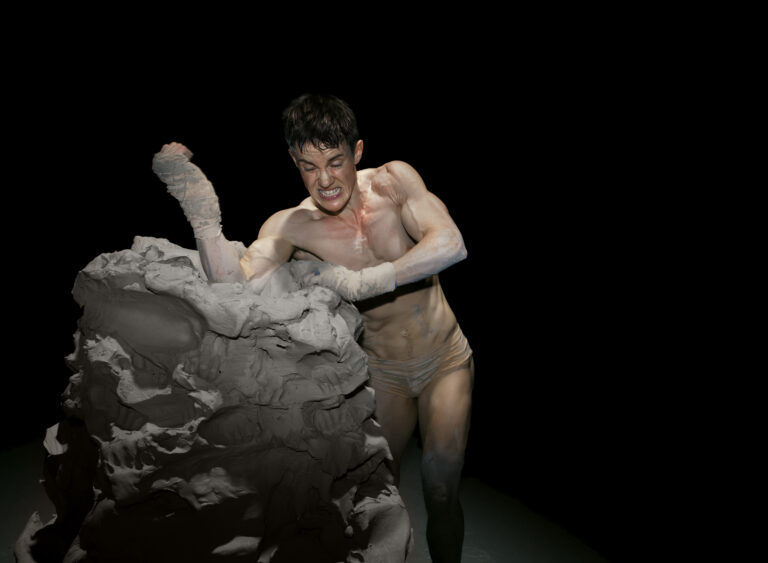
Museums give audiences knowledge and insight, but increasingly the focus is on the nature of the experience. While many collections in museums are by tradition fixed and mute, their contemporary interpretation has taken a dynamic turn as audiences seek more active participation. A material from the earth that engages all human senses and interconnects cultures is clay. When artists and museums occupy their thoughts with clay, they are tapping into its universality through time, environments and societies. In almost all the museums of the world, whether for arts or sciences, artefacts in clay map our capabilities and aspirations – from a clay writing tablet circa 3,000BC to heat shielding ceramics in space shuttles. Clay’s ubiquity encompasses utilitarian as well as symbolic needs with differing conceptions of value – a potter can throw by hand 4,000 disposable terracotta cups a day for use on street tea-stands in India, while a single Japanese teabowl for a tea ceremony can be worth a million yen. Clay traverses birth, life and death, exemplified by figurative representations from ancient history to the present time: tiny clay figures looking like pregnant females made in 26,000BC to the burial site of the Terracotta Army at Xian in 210BC and the life affirming Field by Antony Gormley, a series of 35,000 terracotta figurines, the first version handmade alongside Gormley by sixty members of a brick making family in Mexico in 1991. Clay, its materiality and functions, are therefore both particular and universal: artists, museums and audiences connecting with clay hold the whole world in their hands. As a shape-shifting material coursing through human history, values and meanings are inscribed in myriad processes and contexts. Wet, dry, soft, hard, fragments, volumes, abstract, figurative – with its infinite ability, at any scale, to give form and communicate, how do museums narrate works made of this fleshly material? The answer lies in a museum’s decisions regarding presentation and representation. In Western museums, these decisions have developed significantly as they necessarily reconsider race, religion, gender and social exchange in light of recent technologies and multicultural, postcolonial discourses. Hierarchies of peoples, regions of the globe and cultural framings are being deconstructed and reconfigured; concepts of aesthetics and ethics are open to debate. Traditionally, museums ordered their collections by classification and often highlighted the exemplary or unique artefact, strategies regarded as the locus of authority regarding connoisseurship and curatorship. However, museums today offer an expanded representation, a more inclusive truth: exhibits revealing socially, politically, technologically and environmentally challenging narratives, evidence of a world in flux. The intervention of the artist within the museum space is a catalyst as full of potential outcomes as the material of raw clay itself. The artist and the clay material both have agency, intersecting museum curators’ existing narratives. This manifest agency – physical, imaginative, conceptual, spatial, temporal – enables a dialogue of refashioning and renewal between artist, material, audience, collections and site. This interaction unfixes judgement, classification, authority and order, upending the usual distancing of time, space and memory inherent in the museum-case display. Museums are responding to the artists’ innovatory forms, messages and meanings refracted through the often-overlooked materiality of clay. This expanded field of creative practices is emblematic of the expanded field of vision and understanding between peoples, terrains, beliefs. Between utopia and dystopia lies a new realism, the acceptance of difference, which underpins a museum’s contemporary purpose and its strength. It raises the question of belonging: who belongs in a museum, what belongs in which museum, who appropriates what and when? For example, indigenous peoples throughout the world lead creative lives far removed from museum and higher education institutions, yet their works are collected and prized, which produces an inequitable transaction and lack of reciprocity. Ownership of people and things is still a contested reality and never have museums been more actively engaged in helping to address this through sustainable reconciliation and restitution. Clay, whose handling can heighten states of mindfulness, care and repair, suggests a material echo. This contemporary global condition brings a heightened awareness between artist and audience of their own subjectivity of experience and knowledge, entangled with the subjectivity inherent in any object derived from the conditions and context of its making, its authorship and intention. Neuroscientists have located a tiny area of the brain as the centre of emotional response and conclude that feelings are the key determinant in deciding human actions. While artificial intelligence and virtual reality infiltrate human life, clay heightens feelings of intimacy: it gives birth to form which is at once fragile and resilient in its tactility. Clay excites human consciousness with special potency and poetry, as an earthly material carrying its trace directly from nature. Yet the earth in any part of the globe can be enculturated by humans acting as guardians – or exploiters. Where what is natural is overrun by urban globalisation, the contrast between natural growth and human-centred growth becomes fraught with ambiguity. This becomes a space for the reflective practitioner, whereby clay can come to mimic all the contested states. Clay could be said to offer a new Impressionism: clay, already carrying the impressions of its earthly origin in time and place, is held by the artist who impresses into clay their impressions of lived experience, mediating the potential and purpose of museums in new ways and reinvigorating their audiences