WHY CLAY? WHY NOW?
Excerpts from Clay Seminar No 1. June 9, 2022
WHY CLAY? WHY NOW?
Speakers: Susan Cross > MASS MoCA (USA); Dr Jareh Das > Independent Curator (UK/Nigeria); Dr Sequoia Miller > Gardiner Museum (Canada)
Clay has gained global recognition as a material for curators and artists to examine their practices and on a scale unprecedented in previous decades. Artists and curators who work with clay connect their work to the complexities of material and social histories. Over the past thirty years, much art production has moved from analogue to digital; however, there has been a recent resurgence of interest in clay that transcends art forms, and which indicates a new recognition of this material’s urgent grasp on us. Clay articulately identifies our common causes and our histories that are relevant and overwhelming at this moment. (Introductory text: Clare Twomey, 2022)
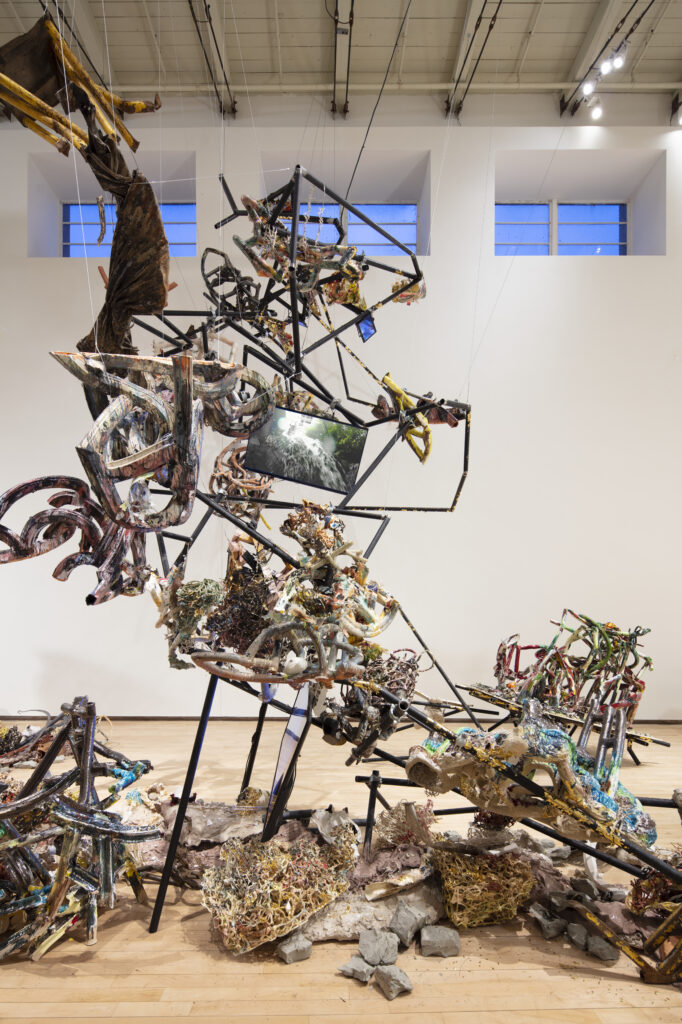
SC: Why clay? Why now? I was thinking about that 10 to 12 years ago when I noticed that all the major galleries were exhibiting clay and ceramics, and even adding artists primarily working in clay to their stables. Before this, I’d seen the work of Betty Woodman and Peter Voulkos and Ken Price in major museums and galleries, but there was a limited and biased view of ceramics in the US, although that seems to have changed over the last decade or so. Not only were ceramic artists joining those galleries that had previously focused on sculpture and painting, but artists who weren’t working in clay started to experiment with it, or perhaps they just got brave enough to bring their clay work out of the studio? As we know, for hundreds and hundreds of years artists have been working with clay on its own and in tandem with other mediums, and in various stages of art production – from studies to moulds to finished work, and even functional objects. When I was organising my exhibition Ceramics in the Expanded Field (2021 – 2023) at MASS MoCA, I was thinking about the 10th anniversary of the ICA Philadelphia’s Dirt on Delight (2009), which showcased clay work spanning four generations. It was a trailblazing exhibition for a museum focused on contemporary art. I wanted to take the pulse 10 years on – to ask what is happening with clay now? While the works in Dirt on Delight were mostly table-top sized, the vast gallery space at MASS MoCA allowed artists who were already working at a large scale to present that work, and it also offered artists who had never been given an opportunity to work so ambitiously the space to do so. So, ‘Why clay? Why now?’ is perhaps a question only for some. For many, clay has always been a fertile medium.
JD: Why now? is connected to the exhibition Body Vessel Clay, Black Women, Ceramics & Contemporary Art (2022). My personal interest is rooted in ceramics in Nigeria, in British Nigeria, and growing up in Nigeria, and also the Middlesbrough Institute of Modern Art … from working in an institution which has a phenomenal collection of ceramics. I’m very much of the generation looking at the legacies of colonialism, and how that relates and traces into the present. It’s these kinds of questions that my curation of the exhibition was trying to raise across two different locations, across different time periods and geographies.
SQ: I think one reason why clay is so potent today is because we are in the midst of a planetary crisis about the survival of our species. A lot of us are trying to understand this new reality and reimagine our relationship to the land – and that clay can actually help us do this. Talking Earth, a public art commission by Santee Smith at the Gardiner Museum, works toward this realignment of our relationship to the earth while also decolonizing museum spaces. The project was led by a circle of Indigenous advisors who determined the scope, focus, and selection of the artist. This piece does the kind of work that only ceramics can do right now.
The current moment for ceramics is informing artists in other ways as well. We just closed an exhibition by multidisciplinary Canadian artist, Shary Boyle, who uses ceramics within a broader practice of social critique. Younger artists – even packs of high school students – were engaging with the work so substantively. It was incredibly restorative for me as a curator to see how deeply people were willing to go into some of the tough questions that Shary Boyle was raising in her work, much of it involving ceramics. Many people are able to see clay in a different way now, and with this growing literacy people are actually able to perceive ceramics with more depth and nuance. We can see this change, like Susan says, over the last ten or so years. What makes clay powerful now is that it has a logic to it. Clay is not just a physical medium but also a way of thinking … it’s a way of understanding yourself in the world.
SC: Thinking through the medium of clay brings to mind earlier debates about craft versus conceptual work, but form and idea meld so beautifully with clay – as Sequoia said: the conceptual is embedded right in the material and not just applied to it.
On connectivity….
JD: Thinking about the landscape of where someone comes from, for Chinasa Vivian Ezugha, clay was something connected to the landscape of the eastern part of Nigeria and a place that she was reconnecting to due to loss – travelling back and going back to perform these funerary rites. That being a potent symbol of the diasporic connection – going back to the land from which one is detached from, and thinking about those movements, migratory movements … reconnection back to the land itself, and one’s roots … and how clay, perhaps, is a material that does that in a really visceral way … This idea around performance and clay makes me think about Jade Montserrat’s piece in the exhibition, where the artist returns to a rural landscape in Yorkshire where she grew up. This raises questions around just who owns the British countryside, and the legacies of slavery that are built into that landscape … the essence of black bodies in that landscape historically, and what it means to intervene within the landscape…
SQ: I think that clay is becoming a tool for us to reimagine our relationship to the planet, because we’re recognising that the global capitalist way that we have of understanding the earth isn’t going to keep working for us. We need some new tools for developing the relationship and squeezing clay is a great place to start!
SC: If clay is intrinsically related to the past, both as one of the earliest materials used for artistic expression, and also one that has been manipulated by so many problematic histories – colonialism, imperialism and more – then it can also be significant to the future. Like the artists in the show at MASS MoCA, many artists are thinking about the past in order to craft a vision of a new future and new ways of being. Clay is a material – in its very nature and how it is fired – about transformation, and it is a language that can push us forward and help us imagine new ways of thinking, being and living.