What is the artwork?
Excerpts from Clay Seminar No 4. June 24, 2022
WHAT IS THE ARTWORK?
Speakers: Cassils > Artist (Canada/USA); Dr Cath Roche > Researcher (UK); Dr Matt Smith > Artist and curator (UK/Ireland).
What is the artwork? Does the art object or event exist as an artwork in its own right? or is it only complete and valid when it connects with the viewer and becomes, to quote artist Clare Twomey, ‘a material catalyst for something else, a cultural provocation?’
Is it the role of the artwork to provoke and challenge? or to empathise or soothe? and what role does the gallery, the museum or institution play in encouraging a connection or a dialogue between the artwork and the audience? What role does the audience play in completing or amplifying the artwork? And what agency does the material have in the work? (Introductory text: Christie Brown & Phoebe Cummings, 2002)
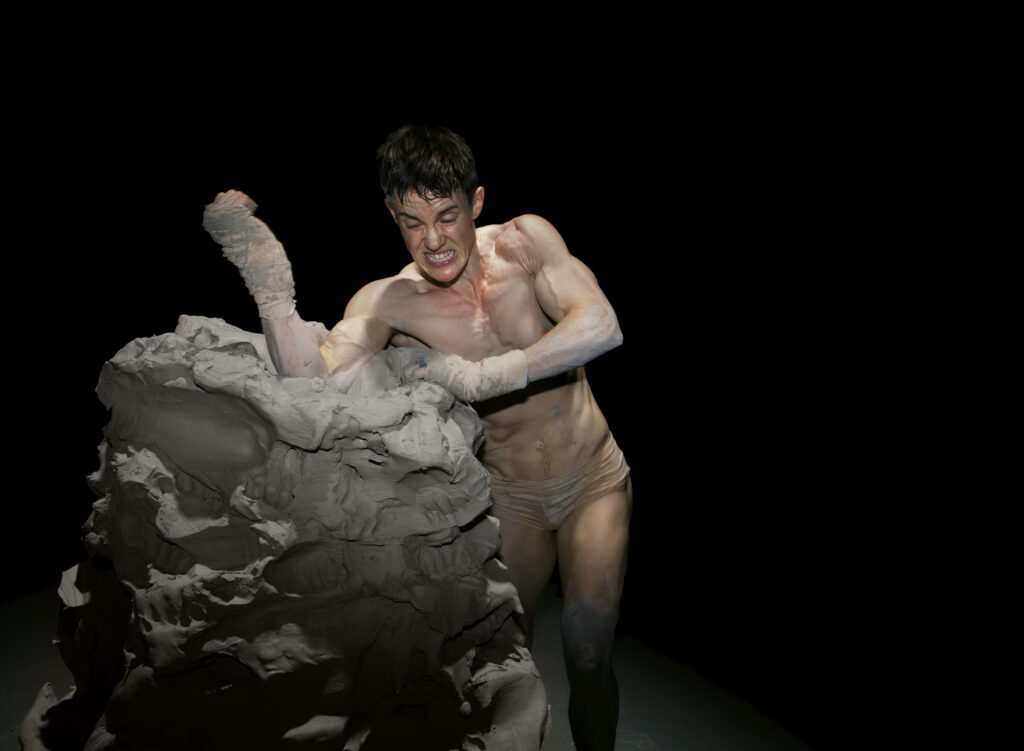
C: I’m an artist who makes my own body the material and the protagonist of my performances. My work contemplates the history of LGBTQI+ violence, representation, struggle, survival. For me, performance is a form of social sculpture, drawing on the idea that bodies are formed in relationship to the forces of power and social expectation. My work investigates historical context to examine the present moment … Land, clod, dust, ashes, dirt, compost, deposit, mould, muck, mud, sod, terrain, turf, sand: The symbolism of clay portrays ideas of renewal and reincarnation, as clay can be infinitely recycled in its raw state … to start over and over again: to be reborn …
CR: I am interested in the transformative power of the artwork as it mediates our experience of the world. An encounter with art is not a disembodied activity; it necessarily involves sensory, conceptual and imaginative processes, and so shapes the lived experience of those who engage with it … Clay and ceramic materiality embodies a uniquely potent, complex character that enfolds within it sensory, sociological, cultural, anthropological and spatio-temporal values. It is sensorially compelling and conceptually rich, embracing both palpable physicality and imaginative realms … Clay-based creations thus repeatedly shift between visceral and cerebral states, and so can be thought of as particularly lively embodied entities … Through their highly charged material being they open up access to a multi-sensory domain. Their inexhaustible, oscillating presence is transformative for audiences, mediating lived experience through physical, conceptual and imaginative means.
MS: I’m most interested in how the noise of the museum, its structures, rules, categories and taxonomies affect how an artwork communicates between myself and the audience. And while the making might concentrate on the artwork, my eyes are firmly fixed on the museum and how it affects and is affected by the artwork. The museum works tirelessly, and for minority groups, usually in an insidious way. Objects are grouped and displayed in ways that reinforce dominant ways of being. Male and female figures are paired up, often arbitrarily. In a world culture museum, it’s hard to forget the impact of British colonisation. And this included the export of British laws to countries that had been colonised. From the 1860s onwards, the British Empire imposed legal codes criminalising male-to-male sexual relations. Within the museum, we often rely solely on written evidence to validate our knowledge and with histories of homophobia, queer knowledge was seldom recorded or preserved.
On Limits and Audience …
C: At my recent solo show at the Institute for Contemporary Art in Perth, Australia, I asked Manuel Vason to turn the camera on the audience … The night after the performance Manuel and I worked late into the next morning creating site-specific wallpaper of the audience members’ reactions to the live events. The performance photographs that are taken blind and at random, are then hung over the audience member wallpaper, so that when the same people who came to the performance, come back again to attend the exhibition the next night, they find their own eyes gazing back at them. This way, I triangulate the viewer, the performer and the camera by folding their gaze into the work itself. I don’t believe in the passivity of an audience; no one gets to stand on the sidelines. If you are a witness, it means you too are alive, present and accountable …
… I’ve been very interested in the problematization of actually creating a visual language that is opaque, that grapples with that concept of what it is to represent a certain subjectivity in a moment [of] … a political law that wants to have you erased and literally annihilated … And so, I’ve been thinking of a sort of formal language to play and to problematize the rules of representation … And that is something that I think we need to continue to move towards, not just in terms of trans and queer subjectivities but, of course, in relation to folks of colour, indigenous folks, even undocumented folks; these need to be taking a much, much greater space in our institutional frameworks … I’m much more interested in creating these moments of complex solidarity across the supposed overarching umbrella rainbow of the LGBTQI movement. There are, of course, class divisions, racial divisions, documented/undocumented divisions, and so really trying to think of very holistic, poetic processes for engaging and moving forward.
MS: We did a really large-scale audience evaluation, because I thought there would be kickback from the media – and there was – and thousands of people were interviewed; what we found was a very, very tiny percentage loved it so much they would give us their firstborn child, and a very, very tiny percentage of people hated it so much that they’d come and burn me out of the house – and the vast majority of people were just like, ‘Okay, I’m up for this’. I think it’s really easy – in a time of culture wars – for us to listen to the very, very small outward edge [of society]. I think it creates fear in all of us when the majority of the population are up for change and being pushed forward, and maybe reviewing things, but I think there will always be work for us to do with curators and museums and trying to encourage them along the road a bit, and to be a bit braver sometimes about what they’d normally talk about or how they’d normally address the world.
CR: Thinking about the limits of an artwork and a viewer’s experience of it, one of the important things to acknowledge is that viewers have to be open to engaging with it. There’s a limit to what the artwork can convey if a viewer is not open, but given that someone wants to engage, an artwork is inexhaustible in that every person has a different perspective, comes to it with a different social or cultural experience, and so each artwork will perform differently depending on the individual viewer. So, I think that’s quite interesting in terms of limits … And in terms of the limits of looking and thinking about how we mostly perceive artwork through a visual context, I’m interested in the idea that our senses are intertwined – that we don’t perceive with one sense and then adopt another depending on what it is we are engaging with, e.g. music or visual art. It’s an integrated perceptual system that works through sensory synthesis, and so I’m interested in the fact that vision is not limited to visual data, but also introduces a tactile element, that when we look at something we also touch it with our eyes … The phenomenologist, Merleau-Ponty proposes that in every sensory interaction there is also a sense of the other, which is interesting when thinking about limits: that if we touch something we are also touched, and if we see something we’re also seen. There’s always a sense of the other within every perceptual experience.